• close up of diamond ring
    Diamonds,  Education

    The 4C’s: Carat Weight

    Carat weight might be the most obvious and straight-forward feature of diamond grading. The metric carat is simply the special unit of weight for diamonds and gemstones, and 1 carat equates to 0.200 gram or 0.007 ounce. Diamond grades are as precise as possible when it comes to carat weight, so let’s take a look at what this process entails and how to understand specific weights.

    Carats & Points


    Diamonds are often so tiny and light-weight that even the metric carat has to be subdivided to produce a precise measurement. That’s why you’ll usually see carat weight expressed as a decimal, like 0.25ct or 1.55ct, but you may also come across something called points. One point (pt) is equal to 0.1 carat (ct).

    100 points = 1 carat

    Points and decimals allow these tiny gems to be weighed super accurately, but you might also see carat weight expressed as a fraction, like 9/10ct or 3/8ct. However, it’s important to note that fractions are often less precise measurements. Typically, the fraction is actually referring to a range of weights rather than a specific measurement, so a diamond marked 9/10ct might actually weigh 0.90-0.95ct. If you come across a fraction weight, think of it as approximate rather than exact.

    You can use the interactive tool below to see how carat weights compare!

    How Diamonds are Weighed


    Electronic scales are the most accurate tools for measuring gem weight. The best are so precise that they can weigh a diamond all the way down to .001ct (or 1/10 point)! Once an unset diamond is placed on the scale, its weight is read digitally in an instant. From there, the diamond’s weight might be recorded exactly as it is, or it may be rounded up or down to the nearest point (or 1/100ct).

    For example, let’s say the scale reads 1.004ct. A diamond grader might record the weight as is, or they might take that number and round it down, labeling the diamond as 1.00ct. Similarly, a diamond which weighs 0.995ct might actually be rounded up, labeling it 1.00ct as well.

    Rounding the weight might seem counterproductive or even imprecise, but even when rounded, diamond weights are accurate to 35 millionths of an ounce! Rest assured that rounding such tiny amounts up or down does not significantly impact a diamond’s final value.

    How Weight Affects Value


    For diamonds, pricing isn’t as straightforward as other things sold by weight. For example, let’s say the price of gold is $1000 per ounce. No matter how many ounces of gold you want to buy, you can just multiply your amount by the per ounce price. So, if you wanted a three ounce bar of gold, you could expect to pay $3000. This is not the case for diamonds!

    When it comes to diamonds, value is all about rarity. So, let’s say you’re looking at a 0.50ct diamond priced at $1,500. Based on that price, you might assume that a 1.00ct diamond of comparable quality would cost you $3000. However, a 1.00ct diamond will actually cost up to 4 times more than a 0.50ct diamond!

    Why? Because a 1.00ct diamond is much more rare than a 0.50ct diamond, and sizes over 1.00ct only get rarer!

    Putting It All Together
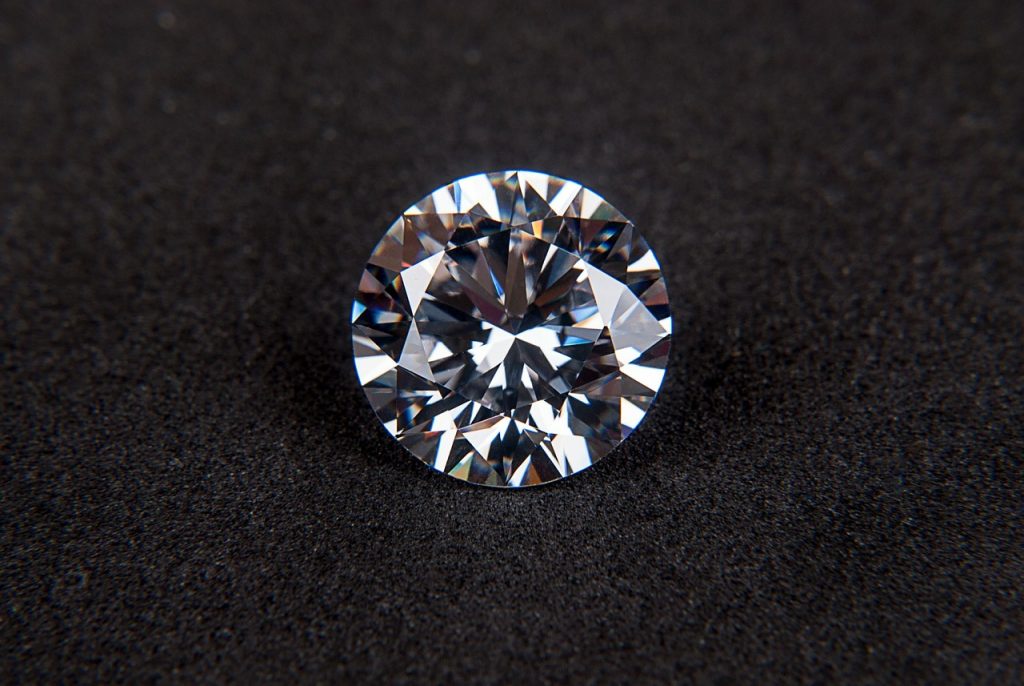

    close up of round cut diamond

    When you’re on the hunt for a diamond, you’ll come across many different stones of the same carat weight and cut style, yet they’ll likely be priced differently. Let’s say you’re looking at two round brilliant 1.00ct diamonds, one priced at $3000 and the other $2000. If you’ve made it this far in our blog series, you’ll have a good idea why! Put simply, the higher priced diamond is more rare.

    Now, based on that, you might assume that all comparable diamonds of the same weight will cost about the same—but they don’t! Believe it or not, a princess cut diamond with the same grade and weight as a round brilliant diamond will actually cost up to 25% less! That’s because all factors of the 4C’s come together to produce a diamond’s final value, and a princess cut simply costs less to produce. On the flip-side, that means you can get a larger princess cut diamond for the same price as a smaller round brilliant!

    When it comes to diamond color, you might find that a 1.00ct natural blue diamond is much more expensive than a 1.00ct white diamond—even if the blue diamond is graded lower in cut and clarity! Why? Because it’s rare enough to find a naturally blue diamond at all—let alone one that weighs 1.00ct after being cut! By the same token, you might find a 1.00ct color-enhanced blue diamond that’s actually less expensive than a 1.00ct white diamond of the same clarity.

    As you can see, each of the 4C’s can raise or lower a diamond’s value in unique ways, and now you know why! If you missed our other posts on clarity, color, and cut, check them out for more details on how each factor affects value.

    If you still have questions, we’d love to help you further! Why not send us a message or pop into one of our stores?

    You can also browse our extensive collection of diamonds and diamond jewelry right here on our website!

    We hope to serve you soon!

  • close up of diamond ring
    Diamonds,  Education

    The 4C’s: Clarity

    Today, we’re going to dive into another part of the 4C’s: clarity. In this context, clarity is defined as “a diamond’s freedom from blemishes and inclusions.” The more free the stone is, the higher the final value will be. Let’s take a look at what these clarity characteristics are and how they’re judged.

    Blemishes


    Put simply, blemishes are irregularities on a diamond’s surface. Sometimes, blemishes are a perfectly natural part of a diamond’s formation within the earth. For example, irregularities in the diamond’s crystal structure can cause a grainy texture to occur.

    Most blemishes, however, are the result of human contact with the stone. Nicks and pits can be formed when a diamond is struck against something, while scratches and abrasions can occur when two diamonds rub up against each other. Similarly, a poor polishing or cutting job can accidentally leave blemishes too.

    Believe it or not, some blemishes are actually added on purpose—in order to enhance the appearance of the stone! For example, a diamond cutter might add extra facets, which can actually remove more obvious blemishes. Nonetheless, extra facets are technically considered to be blemishes, too, since they’re surface irregularities.

    Inclusions


    Inclusions are irregularities inside the diamond. More often than not, inclusions occur as a natural diamond is formed within the earth, but human contact can sometimes create them too.

    As far as natural inclusions go, the diamond’s crystal structure or trapped impurities are the most likely causes. Inside the earth, a forming diamond is subjected to unbelievable pressure and comes into contact with all sorts of other elements. An irregular crystal structure can make a diamond look cloudy, grainy or even colored. Likewise, little bits of carbon or other elements can become trapped inside, causing dark or colored spots to appear.

    On the other hand, accidental blows or a poor cutting job are usually responsible for human-created inclusions. These mishaps can cause bruises, chips, and fractures. However, just like extra facets, a purposeful inclusion can sometimes mask or eliminate other inclusions. An example of this technique is laser drilling, which can dramatically lessen the appearance of dark spots within the diamond. Nonetheless, the drilling process leaves a tiny channel behind, which counts as an inclusion of its own.

    Evaluating Clarity


    A jeweler’s loupe, like the one pictured above, is often used to evaluate diamonds

    A skilled diamond grader uses both the naked eye and powerful magnification to observe and note clarity characteristics. If an inclusion or blemish can be seen with the naked eye, it will have the greatest affect on value. Nonetheless, even microscopic irregularities can impact appearance and durability, so diamonds are inspected under 10x magnification.

    During this process, there are five main factors a grader is considering:

    1. Size: the larger the characteristic, the more visible it will be.
    2. Number: the more numerous, the more obvious.
    3. Nature: is it an inclusion or a blemish? Inclusions are usually considered more important than blemishes.
    4. Position: where is the characteristic located? For example, a diamond’s reflective properties can make one inclusion look like many, while an inclusion on the edge might not be very noticeable at all.
    5. Color: most characteristics are white or clear, but some can be colored or dark. This is known as relief.

    Even though the diamond is examined at all angles, whatever is visible face-up will be the most important. However, it’s important to keep in mind that the grader isn’t thinking about aesthetics alone. Diamonds may be the toughest material on earth, but they can still suffer damage. When fractures and cavities are graded—especially if they’re large—the future durability of the diamond is considered.

    GIA Clarity Scale


    After all the clarity characteristics are observed and documented, the actual grade is assigned. The more effect they have on durability and appearance, the lower the final grade will be. There are eleven possible grades, ranging from Flawless (FL) to Included (I1). Check out the interactive tool below to see examples of each!

    The Bottom Line


    It’s always important to remember that diamond grades are highly technical and not an “objective” standard of beauty. When a diamond is graded Flawless and earns a hefty price tag, it’s ultimately about rarity.

    Believe it or not, only about 2% of gem quality diamonds earn the official Flawless grade. In fact, most diamonds found in stores today are between VS and SI, yet most people would think they’re Flawless!

    As you’ve learned today, inclusions and blemishes can be quite natural and completely invisible to the naked eye. Yet, even when they’re intentional, accidental or quite prominent, they aren’t necessarily undesirable. It all comes down to personal preferences.

    For some, a Flawless diamond created in the lab or by mother nature might be the pinnacle of beauty. For others, a diamond with a unique pattern of dots or lines will feel one-of-a-kind and truly special—indeed, it is one-of-a-kind, as no two diamonds are alike!

    If you missed our other posts about the 4C’s, be sure to read how cut and color are graded too! If you have any questions about the 4C’s or diamonds in general, we’d love to help you further. Why not contact us or pop into one of our stores? You can also browse our extensive collection of diamonds right here on our website!

    We hope to serve you soon!

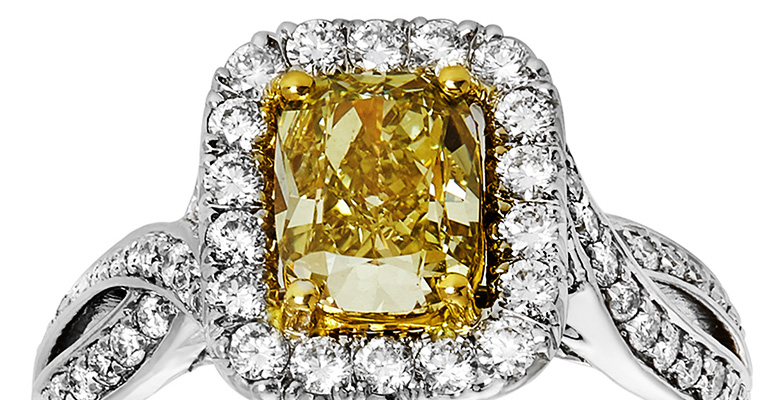
  • Fancy yellow diamond ring
    Diamonds,  Education

    The 4C’s: Color

    When you hear the word “diamond,” what’s the first image that comes to mind? If you’re like most people, you might imagine a dazzling colorless gemstone—but did you know that truly colorless diamonds are extremely rare? Not only do most diamonds have a tint, but they can be vividly colored too! Today we’ll take at the look at how a diamond’s color is graded as part of the 4C’s.

    The Normal Range


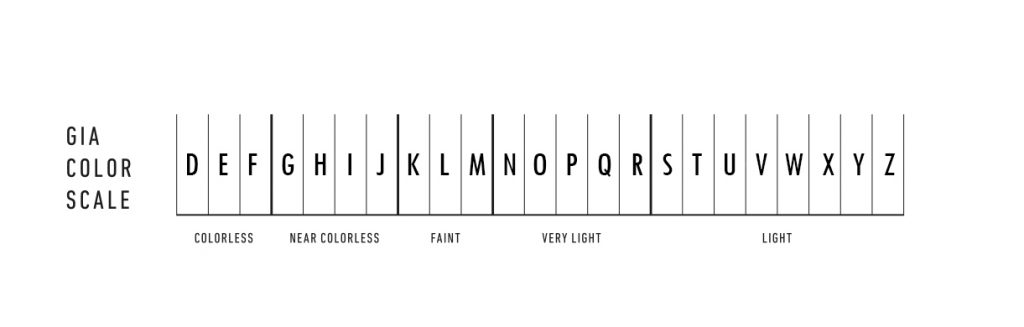
    GIA diamond color scale
    Most diamonds fall within the colorless to yellow, brown or gray range – GIA.edu

    While diamonds can be any color of the rainbow and more, most fall within a certain spectrum. The vast majority of diamonds available today range from colorless to light yellow, brown or gray. You can think of this spectrum as the “normal range.”

    Trace elements—like nitrogen or boron—that enter the diamond as it forms are mostly responsible for this range of color, but the stone’s crystal structure can also play a role. When intense pressure distorts a diamond’s crystal structure, hues like brown, pink, red and purple can appear. It’s only when a diamond’s chemical and crystal composition are close to perfect that colorlessness results. Otherwise, at least a faint tint will be detectable.

    The GIA color scale for normal range diamonds goes from D (colorless) to Z (light)
    The GIA normal range color scale

    The Gemological Institute of America (GIA) has developed the most popular grading system in the US, so we’re going to use their scale.

    For diamonds in the normal color range, an alphabetical spectrum from D (colorless) to Z (light yellow, brown or gray) is used. However, these letters don’t actually refer to specific colors. Instead, they simply mean that the diamond falls within a precise range of color. Therefore, two diamonds which are both graded H can actually look a bit different from each other.

    Nonetheless, these grades are very technical. In fact, it’s typically only the experts who can tell a D diamond from an H diamond when it’s mounted in jewelry. Indeed, even diamonds graded K, L or M will usually appear quite colorless if they’re under 0.5ct.

    When it comes to this scale, you can typically expect a diamond’s value to correlate with how colorless it is. The closer a diamond gets to a D grade, the more valuable it will be. However, when a diamond is graded below a Z, that’s no longer true. In fact, these special diamonds are valued for their color—not their lack of it! Let’s take a look at them next.

    Fancy Color


    Examples of rough and cut fancy color diamonds in blue, yellow, aqua and pink
    Check out these blue, yellow, aqua and pink fancy color diamonds! – GIA.edu

    If a diamond doesn’t fall within the normal range, it’s considered fancy color. This includes black, blue, red, green, vivid yellow and much more. These diamonds are very rare in nature and are valued accordingly. Believe it or not, the entire world only produces a few thousand carats of fancy colors each year! When it comes to grading them, three qualities are considered: hue, tone, and saturation.

    Hue is simply the diamond’s color category. These categories can be a single color (like red or blue) or some combination (like reddish-orange or bluish-green). Tone refers to the color’s lightness or darkness, while saturation (sometimes called intensity) is the color’s strength and purity. You can see the interplay between these qualities in the chart below.

    The GIA fancy color grading scale
    The GIA fancy color grading scale

    The GIA fancy color scale ranges from faint to fancy deep, but you can’t look to the very top or very bottom of this chart to determine value. Instead, the most valuable grades are found near the middle, with fancy vivid being the most valuable of all. Why? As always, it’s about rarity. Fancy color diamonds with super high saturation and a light to medium tone are extremely hard to find, and their price will always reflect this.

    Examples of different yellow diamond grades, ranging from fancy light to fancy vivid – GIA.edu

    However, it’s important to note that what these grades actually look like is completely dependent on the stone’s hue. Say you’re comparing two fancy vivid diamonds: one yellow and one blue. You may notice that the blue diamond appears paler and less saturated than the yellow one—yet they have the same grade! Why? Again, it’s all about rarity.

    Believe it or not, each hue has it’s own spectrum of possible saturations and tones, so the grading scale is reinterpreted to reflect these differences. It simply wouldn’t make sense to grade blue diamonds by comparing them to how saturated or intense yellow diamonds can be. Instead, they are graded against other blue diamonds—which happen to be much harder to find than yellow ones!

    At first, this may seem a bit complicated, but it actually helps to keep things simple! No matter the hue, fancy vivid is like a D rating on the normal range scale—it’s the most valuable simply because it’s the most rare.

    If you ever start to get confused, just remember: grading isn’t about ranking how beautiful a given diamond is—a diamond of any hue, tone or saturation can be absolutely breathtaking. It’s all about rarity.

    Color Enhancements


    Thanks to modern technology, the color of a diamond can sometimes be changed! We won’t get into how this scientific marvel is achieved in this post—you can read our article about diamond treatments here—but these treatments do affect value, and I bet you can guess why. That’s right—we’re talking about rarity!

    Though these treatments can make a diamond colorless, black, or practically any color of the rainbow, they will be considered less valuable than their natural counterparts—sometimes the difference in value can be well over 50%! As always, it’s because naturally colored and colorless diamonds are more rare. Nonetheless, these treatments can sometimes increase the value of a diamond well beyond what it would fetch had it not been treated.

    If a diamond has undergone any treatments, it will be disclosed on the diamond’s grading report. This makes it easy to understand why two diamonds that look almost identical are valued so differently! Let’s dive into how that report is created.

    The Grading Process


    So, we’ve seen what the possible grades are, but how are they actually determined? After all, there are so many possible tints and colors, plus so many different conditions under which to view them. That’s why super precise methods have been developed by GIA and other labs around the globe. Even though these methods differ somewhat for the normal range vs. fancy color, they share most of the same steps.

    Chiefly, diamonds of any color are graded relative to other diamonds of known color. These are called master stones, because they’re considered the standard for each hue. Master stones make it much easier to determine exactly where a given diamond ranks on the possible color scale.

    An example of GIA master stones

    Next, the lighting conditions are perfectly controlled. Graders typically work in a rather dark room with a special light source that’s optimized for color perception. Then, both the master stones and the diamond to be graded are turned upside down. Why? Because this minimizes reflections, which can alter the way the color appears.

    However, fancy color diamonds are not turned upside down when graded. That’s because the way a diamond is cut can influence the way its color appears too! Therefore, it’s actually more accurate to grade fancy colors face up.

    Today, special instruments have been developed to aid in the process of grading, but they’re not 100% accurate. Believe it or not, nothing can quite beat the precision and accuracy of the well-trained human eye—at least for now!

    The Bottom Line


    Beauty is in the eye of the beholder.

    For diamond color, that saying has never been more true. Whether you’d like a rare pink diamond or a colorless classic, it’s all about what you find most alluring. The price, however, is a carefully considered valuation, and now you know how and why!

    If you missed our last 4C’s post about cut, why not check it out now and find out how that quality is graded too? Next time, we’ll explain how a diamond’s clarity is graded, so be sure to stay tuned!

    In the meantime, why not stop by one of our stores and see our collection of loose diamonds and diamond jewelry up close and personal—even under our microscope! Or, you can view our extensive diamond collection online here and our diamond jewelry here!

    We hope to see you soon!

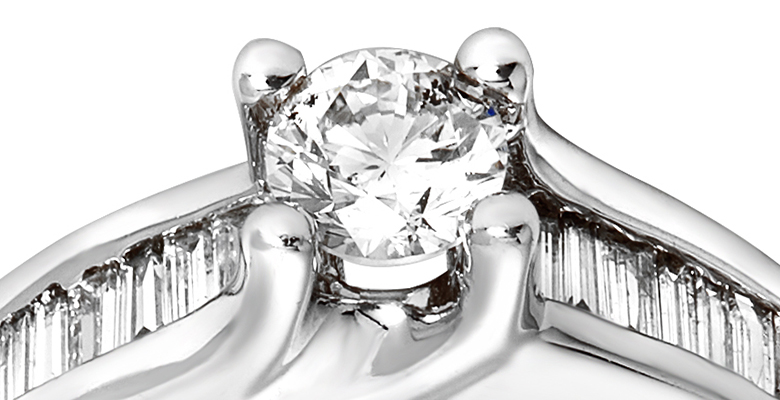
  • close up of round and baguette diamonds
    Diamonds,  Education

    The 4C’s: Cut

    Whether you’re on the hunt for the perfect diamond engagement ring or trying to evaluate antique diamond jewelry, there’s a lot to consider before making your decision. So many different factors go into grading and valuing diamonds, and it can all seem a bit overwhelming at first glance—but don’t worry! We’re here to make it easy.

    You may have heard of something called “The 4C’s,” which is a short-hand way of describing the four major qualities used to assess a diamond’s value: cut, color, clarity and carat-weight. In fact, you may have read our overview of this process here! But if you’re still wondering exactly how to make sense of it all, we’ll be giving you an in-depth look at each quality over the next few weeks right here on our blog.

    Today we’re going to go over Cut, which is probably the most complicated—and sometimes underrated—of all the diamond grading qualities.

    Cut Style vs. Cut Quality


    When you hear the term “cut” in relation to diamonds, it can refer to two different things. First, there’s the shape and faceting style, which is typically categorized as either “round brilliant cut” or “fancy cut.” Second, there’s the cut quality—the diamond’s proportions, symmetry and polish—which is what “cut” refers to in the 4C’s. However, that doesn’t mean that cut style has no effect on value.

    There’s a vast variety of cut styles available today, allowing more individuality than ever in jewelry making. You’re probably familiar with the classic round brilliant cut and popular fancy cuts like the emerald or princess cut, but if you dabble in antique or custom jewelry you’re likely to come across styles you won’t find in your average jewelry store! Antique styles like the rose cut or mine cut are rare today, while modern diamond cutters have been producing completely new styles that resemble flowers, butterflies, and more!

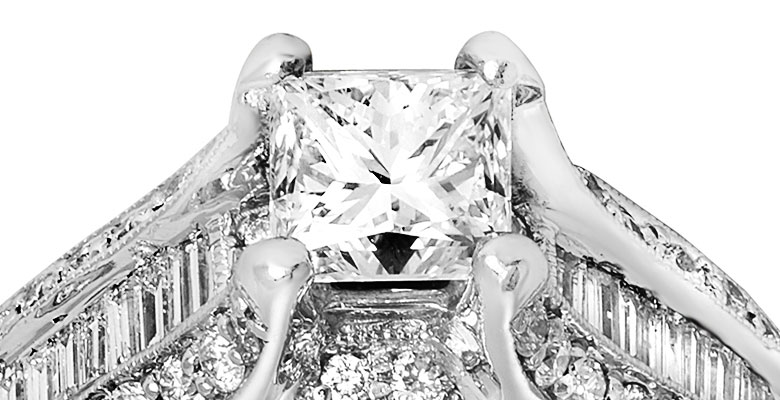
    white gold diamond ring featuring princess, round brilliant and baguette diamonds
    This ring features a princess cut diamond at the center accented by a halo of round diamonds plus four baguette diamonds on the shank – available here!

    Though you should always choose the diamond cut style that suits your personal preference, it’s good to keep in mind that the relative popularity of certain shapes and how labor-intensive cutting can be has an effect on value. The round brilliant cut has been the most popular shape for over a century, and lots of time and energy has been put into making sure it is cut to exacting standards. Therefore, it’s no surprise that its price reflects its special status. For example, a round brilliant cut diamond with the exact same 4C’s grade as a marquise cut diamond will actually cost more. Likewise, especially rare and unique cuts will also fetch more on the market.

    All that being said, the actual cut quality—no matter the shape chosen—has the most impact on overall value, so let’s take a look at how it’s graded.

    Cut Quality


    Diamonds graded excellent, good and poor
    From left to right, these diamond cuts were graded Excellent, Good, and Poor – GIA.edu

    The cut quality of a diamond really stands out in the 4C’s because it has the greatest single influence over the brilliance of the stone—plus, with the exception of lab-grown diamonds, it’s the only quality we have much control over! A skilled gem cutter can make all the difference in the world when it comes to bringing out a diamond’s signature beauty.

    As specified above, cut quality is determined by proportions, symmetry, and polish. Today, diamond cutters use precision instruments so that ideal proportions and angles can be achieved which maximize the brilliance (reflection), dispersion (fire) and scintillation (sparkle) of the diamond. Basically, all those facets (flat, polished surfaces) gather light from all directions and then reflect it back to us, producing that dazzling effect only a well-cut diamond can produce! Let’s dive a little deeper into just how that dazzle is measured.

    Brilliance

    Brilliance is the total intensity or amount of light that is reflected from both the diamond’s surface and interior. The awesome thing about transparent gemstones is that light isn’t just reflecting off the surface—like it does on pearls or jade—it’s also being reflected from inside the stone!

    Dispersion

    Dispersion is what happens when white light is split into a rainbow effect, like what you see when light enters a prism. When it comes to diamonds, this stunning display of color is known as “fire.”

    Scintillation

    Scintillation sounds complicated, but it’s really just that dazzling sparkle you see when you move a diamond around! The sparkling can vary based on the pattern of light and dark areas in the diamond.

    Those are the basic optical effects a diamond grader is looking for, but the grading process actually gets much more technical as it proceeds. Taking a look at the anatomy of a cut diamond will help show us just how precise it gets and why these technical details not only maximize the beauty of the diamond, but also play an important role in its durability.

    Features of Cut


    Profile of a Round Brilliant Diamond – GIA.edu

    Almost all cut diamonds have two main parts: the crown (the upper part) and the pavilion (the lower part). The angles and depths of these two parts are measured against ideal percentages which have been found to produce the most dazzling effects. Where the crown and pavilion meet is called the girdle, which is the widest part of the diamond. The width of the girdle is important because it acts as the setting edge when the diamond is secured in a piece of jewelry, but a balance must be struck.

    If the girdle is too thick, the diamond will appear smaller than its carat-weight would seem to indicate and may actually be difficult to set into jewelry. However, if the girdle is too thin, the diamond will be at an increased risk of chipping which is a major risk to the longevity of the stone. Therefore, a width somewhere in the middle is usually preferred, with round brilliant cuts leaning more towards a thinner girdle and fancy cuts leaning more towards a thicker girdle.

    Similarly, the culet facet—which is a cut at the base of the diamond—shouldn’t be too small or too big. Too small (or nonexistent) and it won’t protect the base of the diamond from chipping. Too large, however, and it will appear to be a big black spot in the middle of the diamond!

    Overall, the main thing a diamond grader is looking for here is symmetry and proportion in accordance with the ideals for each shape. Is the table slightly off-set or precisely centered? Is the girdle wavy or perfectly straight? Are the crown angles exactly the same around the entire diamond or do they vary? Is the pavilion angle too steep or too shallow? The more symmetrical, proportional and ideal these measurements are, the higher the diamond will be graded. Let’s take a look at what those grades actually are.

    Cut Grades


    Diamond grading examples – GIA.edu

    The Gemological Institute of America (GIA) has developed the strictest diamond grading scale, and it’s their standards we’re going to go by here. Diamond cuts are graded on a scale of Excellent to Poor, taking into account all the factors detailed above. The profile diagrams next to each diamond in our example will help us compare and contrast each stone and easily see why their grades vary so much.

    For example, when comparing the Excellent diamond against the Good diamond, you may notice that the Good example has a shallower crown and pavilion, which contribute to its poorer optical performance (note how much darker the Good example appears when compared to the Excellent example). You may also notice that the pattern of dark and light areas in the Good example are not as symmetrical as in the Excellent example.

    All of these issues are especially pronounced in the Poor example—we can see that not only are the proportions quite different from the others, but that the girdle is extremely thick as well. The result? A rather dark diamond that will appear smaller than its carat-weight would suggest and will never sparkle quite like the others. These are the tell-tale signs of a poor-quality cut.

    The other quality a diamond grader would be looking at is the polish of the diamond’s facets. Basically, the facets should be smooth and lustrous, or else the diamond’s reflections won’t be crisp and can even contribute to trapping oil and dirt—major hindrances to achieving that coveted sparkle! Indeed, a poor polish job will make an otherwise lovely diamond look quite dull.

    All of these factors are studied under microscopes, carefully measured, and then precisely calculated before assigning the diamond its final cut grade. As you might expect, the higher the cut grade, the higher the value of the diamond will soar. However, it’s not just because Excellent and Very Good diamonds are more dazzling; it’s also because they necessitate sacrificing more of the original raw diamond. Every facet has a cost, and a quality cut ensures that these sacrifices are not in vain.

    Check out the interactive tool below to see even more detailed examples of all the cut grades!

    Bottom Line


    Cut quality doesn’t always receive the love it deserves when it comes to producing dazzling diamonds, but now you know how important it really is! The standards of diamond cutting are no accident—they’re our human contribution to these gorgeous gifts from nature. Combining all we’ve learned about mathematical angles, proportions, and the interplay of light, we can shape these stunning objects of fascination and desire, revealing more and more of their unrivaled beauty as the field of diamond cutting continues to advance.

    Next up, we’ll tackle the grading process for Color, so make sure to check back soon! In the meantime, why not stop by one of our stores and see our collection of loose diamonds and diamond jewelry up close and personal—even under our microscope! Or, you can view our extensive diamond collection online here and our diamond jewelry here!